AI is already in email, in the CRM and in the heads of much of the team — with or without the company’s permission. Blocking it outright tends to push use into the shadows. Opening it with no judgement creates data leaks, mistakes that “look true”, and regulatory risk. The middle path is adoption with training.
This article sums up common risks and how to tackle them with microlearning. The practical pack is the AI pathway.
The key idea. The risk is not only the model. It is the person who pastes a customer’s details, a contract or a payroll into a generic chat “to go faster”.
1. Shadow AI (use without governance)
Talking about shadow AI means talking about what already happens in many companies. Someone uses a personal tool, a free account or a plugin nobody has approved, and HR or legal find out late — sometimes only after an incident.
That leaves data outside the perimeter, makes it hard to audit what has been shared, and means each person gets different answers depending on the tool they happen to have. It is worth training people on when to use it and when not to, on the approved channels, and with examples from the job. The microcourse on responsible and ethical use of AI fits well as a base.

2. Sensitive data and confidentiality
Another everyday risk: pasting customer, patient or employee information, or source code, into an external chat “just for a moment”. It is usually the most expensive shortcut.
Here, training does not replace digital hygiene: AI often complicates it. You need a basic classification of data, a clear “do not paste this” rule and, where it fits, reinforcement with cybersecurity from the catalog.
3. Hallucinations and poorly grounded decisions
AI writes with confidence. That does not mean the figure, or the legal reference, is true. In sales, support or compliance, a mistake in a convincing tone can reach the customer or an audit.
It is worth training people to check sources, to use AI as a draft — not as an authority — and to cross-check. It helps to practise how to write prompts that produce results you can use and review.
4. Bias and unequal treatment
Models are trained on data that can carry bias. It shows up in hiring, in appraisal and in customer service. Even if “the AI wrote it”, the organisation is still responsible.
Training here is about concrete examples, human review of high-impact decisions, and clear limits on use in HR.
5. Intellectual property and third parties
You also have to look at what gets generated and what gets published: images, text or code, without checking licences, trademarks or customers’ rights.
In practice, the team needs to know what can be published, what has to be reviewed, and when to ask for permission — the same line of responsible use as in the risks above.
6. Compliance (the AI Act and literacy duties)
The AI Act is not only a matter for the people who build models. Organisations that use AI systems have duties of AI literacy and of risk management, depending on the context.
Training here means explaining, in plain language and with cases from the sector, who is obliged to do what. A good starting point is the AI Act in bite-sized form.
7. False productivity (and dependence)
Copilot and other tools can speed the work up, or they can create more work in review. Without judgement, the team copies poorly and the manager loses time correcting it.
What helps is training on real office workflows: when to delegate, when not to, and how to review. For example with Master Copilot.
Why microlearning (and not a policy PDF)
Policies get signed and, often, forgotten. The risks show up in the micro-moment: “I need this email now”, “I’ll summarise this contract”, “I’ll translate this ticket”. That is when you need a short bite, an example from the job and a quiz — the same standard as in the microlearning guide.
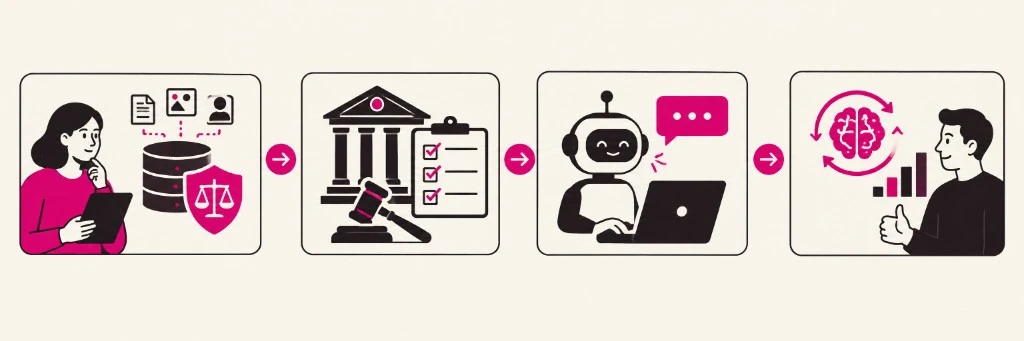
An ordered pathway avoids the monster course on “everything about AI”:
- Literacy and ethics — limits and data.
- Regulation — the AI Act in language people can act on.
- The job — prompts, Copilot, cybersecurity.
- Reinforcement — short tips when the tool changes.
The detail of the pack is in the seven AI microcourses and on the AI in training page.
How to talk about it with leadership (without alarmism)
If you have to take it to leadership, a practical tone is the right one, not an alarmist one. The cost of a data incident usually exceeds the cost of training the workforce. Training is part of meeting the literacy duty, not only “innovation culture”. And it makes sense to start with high-risk roles (customer service, legal, data, managers) and widen from there.
Adoption with judgement, not with fear
Blocking AI does not remove it: it pushes it into the shadows. Opening it without training multiplies expensive shortcuts. The balance is shared judgement — data, verification, approved channels — in bites people can apply the same day.
If you already have the diagnosis and you are missing the pieces, the AI pathway puts ethics, regulation and the job in order. The microcourses linked above cover each risk without a monster course.