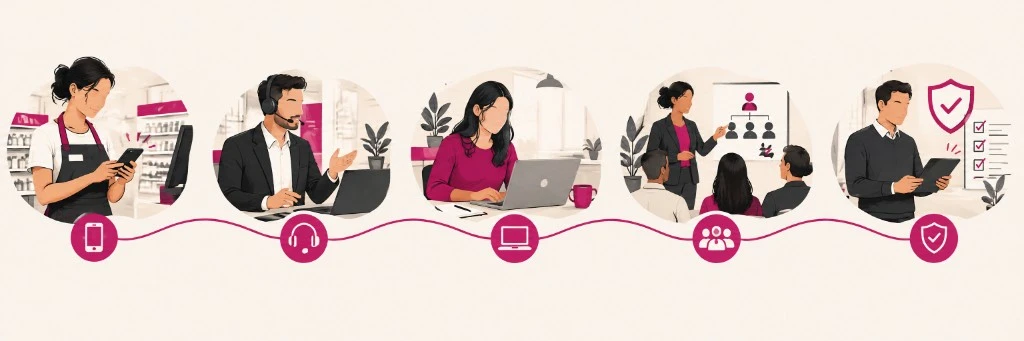
In many companies the three-hour “welcome course” tries to do everything: culture, tools, compliance, and product. The result is usually overload on day 1 and forgetting by day 15. In this article we explain how to separate onboarding and training — and measure them with different KPIs — so you avoid that bottleneck.
Short definition. Onboarding = bringing the person into the role and the organization. Training = developing or updating competencies over time. They combine; one does not replace the other.
What onboarding is (and what it is not)
Onboarding answers: “What does this person need in order to be operational and feel part of the team in the first weeks?”
It includes, in reasonable doses:
- Culture, values, and “how we work here”.
- The essential tools (not the full manual).
- Safety and the critical rules of the role.
- Contacts and rituals (who helps, how to ask for support).
It is not the place for the in-house master’s in sales excellence, or for the whole year’s compliance catalog.
At Snackson, onboarding can live as a pathway of pills or with Bienvenida.pro, designed for joining the team without overload.
What training is
Training (continuous learning) answers: “What skill or knowledge does the team — or this role — need now in order to improve the result?”
Examples: a new product, objections, an updated GDPR, specific health and safety, AI literacy. Pathways from the catalog, reinforcement after a face-to-face session, and just-in-time campaigns fit here.
How they relate
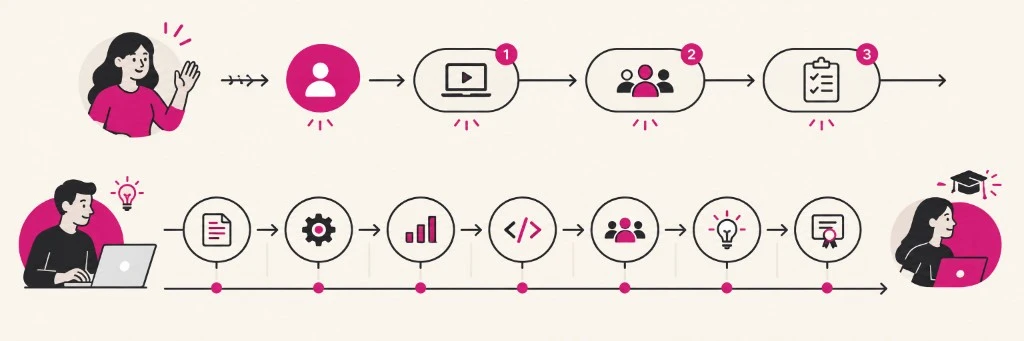
A healthy pattern is usually this: short onboarding (days or weeks) with what is critical for days 1–30; training in waves, with the role’s skills paced out; and reinforcement snacks when something is new, without opening another “welcome course” — knowing how to tell snackable content and microlearning apart.
If you already have a Moodle campus, microlearning can complement the LMS without replacing it, with Snackson in Moodle.
Typical mistakes
The usual pitfalls are loading the entire company PDF on day one (maximum cognitive load, minimum retention); measuring only attendance at the welcome session (showing up is not applying); forgetting the manager (with no checklist and no visibility, onboarding fails); and mixing KPIs, using “training hours” as the only indicator of a good onboarding.
Onboarding KPIs that actually help
Choose a few. Three measured well are better than fifteen on a dead dashboard.
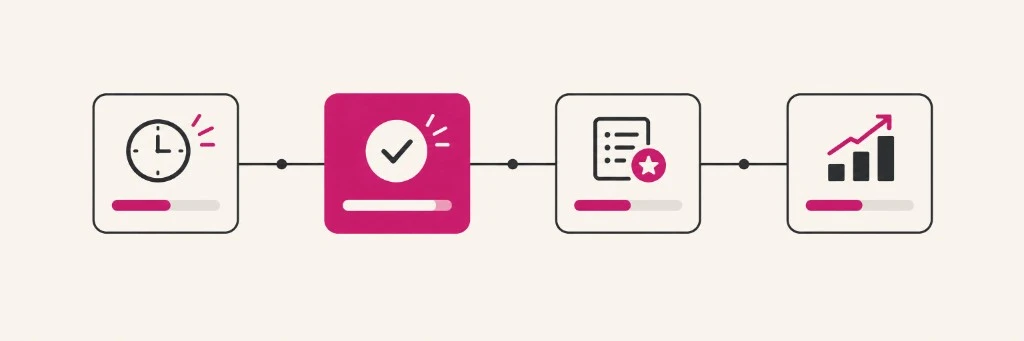
Days until an agreed threshold (minimum sales, tickets resolved, shifts worked independently). Define the threshold before you train.
% who finish the mandatory pills on time (e.g. week 1 and week 4). If it is low, it is usually the design or the channel — not “a lack of motivation”.
They show whether the content is understood. A 100 % click rate with 40 % correct is a warning.
“Did I know who to ask?” “Did I have what I needed in the first week?” eNPS or 2–3 questions; avoid surveys that run on for miles.
Checkout errors, safety incidents, time to first sale, internal tickets. The bridge between L&D and leadership.
Training KPIs (so you do not mix them)
In continuous training, look more closely at coverage of the group, spaced repetition, transfer to the job, and content expiry — and the hidden costs of e-learning if the budget is tight.
Microlearning in the welcome
The short format fits reality: a new person does not have “free mornings”. One objective per pill, mobile, and pace avoid the day-1 bottleneck. The general criteria are in the guide for companies; expectations by role help you avoid designing “for everyone” and serving no one.