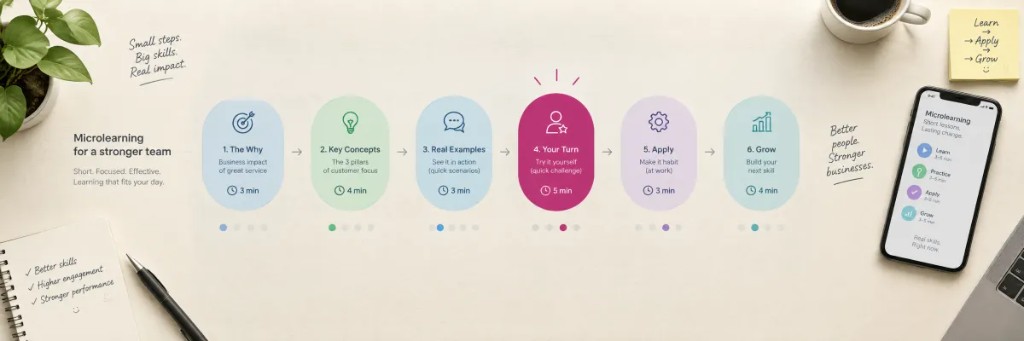
In marketing, “snackable” means content that is short, visual, and easy to share. In training, the word has slipped into briefings and RFPs… often as a synonym for microlearning. It is not. Confusing the two leads to campaigns of loose tips with no learning — or to rigid pathways when a reminder would have been enough.
At Snackson we have spent years talking about “bites”. This article clarifies the difference on practical grounds.
In one sentence. Snackable content is a short piece that works on its own (reinforcement, notice, tip). Microlearning is a design: a single objective, a sequence, a channel, and evidence that someone learns and applies it.
What snackable content is
It is brief, standalone content: a card, a 60–90 second video, a tip in the chat, a carousel, a “fact of the day”. It is consumed in a spare moment and does not require having seen anything before.
It works well for:
- Reminding people of a protocol on the day it changes.
- Pushing a culture or internal-communication message.
- Whetting the appetite for a longer pathway.
- Reinforcing a concept days after a pill.
On its own, it is not enough to certify a competency, or to replace a program with measurable business objectives.
What microlearning actually is
Microlearning is an instructional design philosophy: very small modules, one objective per unit, interaction, and a channel that sets the pace. We set this out in the microlearning guide for companies.
The piece can look “snackable” (3–5 minutes), but the system includes:
- Sequence (what comes before and after).
- Feedback (quiz, scenario, decision).
- Delivery or access designed for the job (mobile/web).
- Traceability (who completes it, what they get wrong).
Without that, you have a library of tips. With it, you have a habit and evidence.
Differences in practice
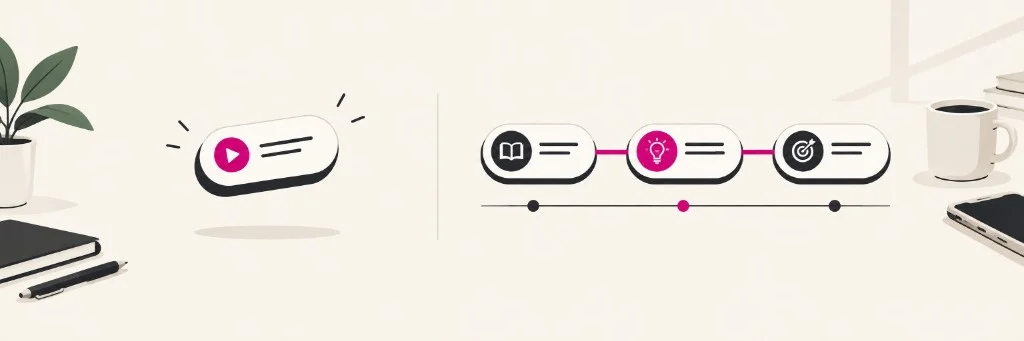
If you set them side by side, snackable content is a standalone piece (an attention or tip objective; order hardly matters; feedback is optional; you measure reach, and it expires quickly). Microlearning, by contrast, is a pill inside a pathway: order matters, there is almost always feedback, you measure completion and application, and it is reused or updated with more judgment.
A standalone piece; a tip or attention; flexible order; optional feedback; reach is what gets measured.
A pill on a path; a competency or an action; order; feedback; completion and application.
When to use each one
Prioritize snackable content when you need to communicate now, reinforce a launch, or keep a topic “hot” without opening a course. Prioritize microlearning when the business asks for a change in behavior, paced onboarding, light compliance, or skills that are demonstrated (sales, health and safety, cybersecurity, AI…).
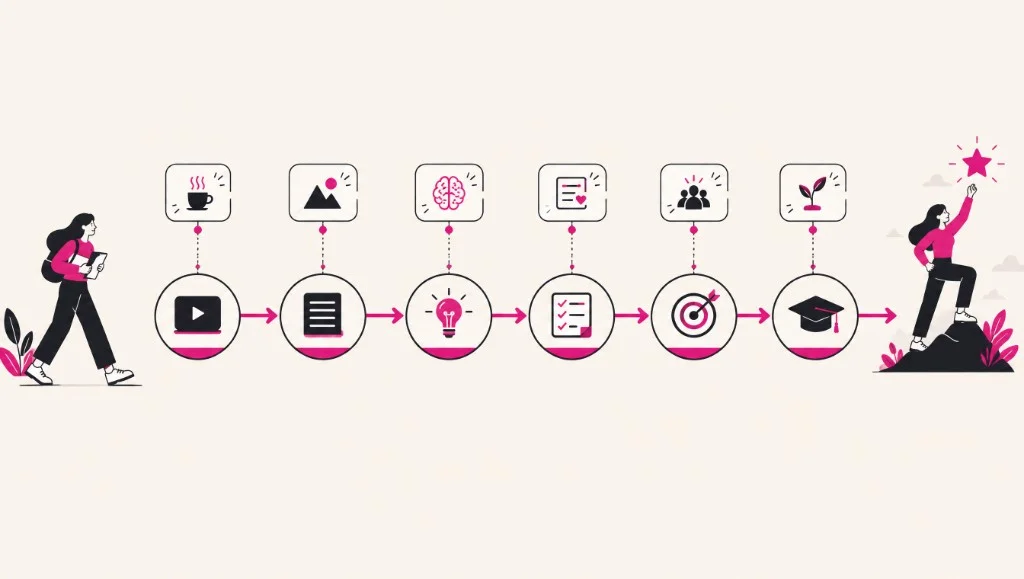
And combine them when the pathway is the trunk and snackable content is the reinforcement: a tip on Monday, a pill on Tuesday, a reminder on Friday. The channel — not the PDF — is what makes that actually happen.
Common mistakes
It is worth avoiding, above all, relabeling a 2-hour course as 20 clips and calling it microlearning (it is still the same wall, chopped up); measuring only likes or opens when the business KPI is “fewer errors at the checkout” or “fewer phishing tickets”; publishing snacks with no owner (nobody updates them or retires what is obsolete); and forgetting the context of use: a generic tip does not help the store team at 11:00 between customers.
How we approach it at Snackson
We design pills with one objective and distribute them at a set pace. When a one-off reinforcement is needed, it can live as microcontent inside the same channel — not as a loose thread across five different tools.
For the full criteria, the microlearning guide for companies; for pieces that are ready, the catalog; if the knowledge is yours, custom courses.